Exporting transcriptions and citations
Two exports meant for people who write: the text of transcriptions to bring into an article, and bibliographic citations to put into Zotero or LaTeX.
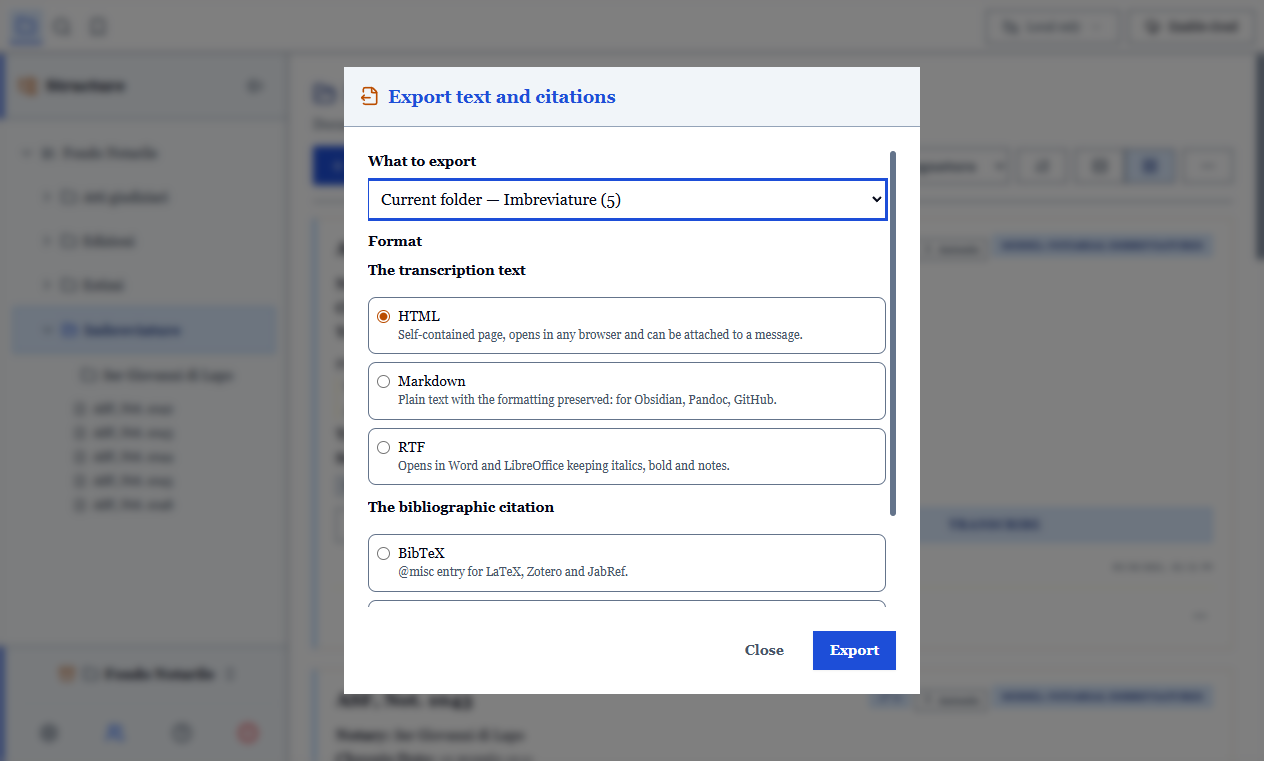
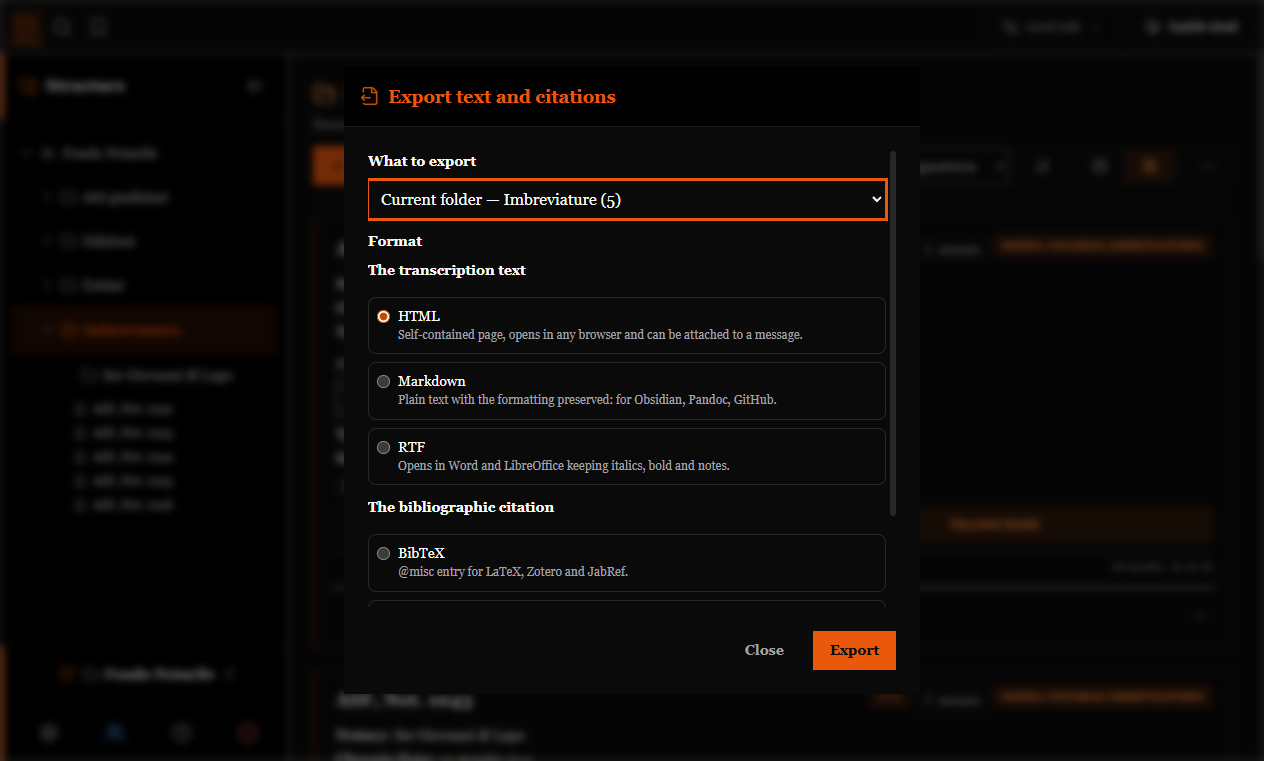
They are reached from the right-click menu of a record or folder (Export, Export text), from the command palette and from the export button inside the transcription environment.
Five formats
| Format | What it is for |
|---|---|
| HTML | A standalone file that opens in the browser and can be sent to anyone |
| Markdown | Bringing the text into a modern editor, a website, a repository |
| RTF | Opening in Word or LibreOffice with formatting preserved |
| BibTeX | Citing in LaTeX |
| RIS | Importing into Zotero, Mendeley, EndNote |
What comes out
For transcriptions: the scope you choose (open record, selection, folder, filtered archive), with folio headings.
A record without a transcription does not vanish from the file: it appears with its heading and the note "No transcription". An export that silently drops three records out of twenty is worse than an empty one.
OCR uncertainty survives
Words flagged as uncertain by automatic recognition stay marked:
- in Markdown they become
[?], the philological convention for a doubtful reading; - in RTF they keep the wavy underline;
- the provenance note ("this text comes from automatic recognition") is carried over.
This is deliberate: an OCR draft that leaves the program without saying so would become a falsely authoritative transcription in someone else's article.
Citations
BibTeX and RIS produce one entry per record, of type "manuscript", with fonds, author and date taken from the headers set for printing: they are the same data, and a second copy would end up stating a different fonds in the .bib file and on paper.
Two precautions already handled:
- the title is protected from the capitalisation rules of bibliographic styles, which would otherwise lowercase proper names;
- citation keys are deduplicated: two folios by the same notary in the same year exist, and without a suffix the second citation would point to the wrong document.
The year is extracted only if plausible: a register number will never end up as a year.
Before exporting
The open transcription is saved automatically: the latest text you wrote is exported too, not the previous version.